

Festive Season 2026: How Garment Businesses Can Prepare, Sell More & Stay in Control
For garment businesses across India, the festive season is the year’s defining chapter Navratri , Dussehra , Diwali , Eid , Christmas. Wedding season running alongside all of it. From September through December, footfall surges, wholesale orders spike, exhibition calendars fill up, and the pace of billing, restocking, dispatch, and returns accelerates like nothing else in the year.
This festive season, the garment businesses that win won’t just work harder. They’ll prepare smarter. They’ll know their stock, their numbers, and their operational gaps before the rush hits – not during it.
This guide gives garment retailers, wholesalers, and manufacturers a practical playbook for festive season preparation in 2026 – and shows how the right garment store management software keeps everything under control when pressure is highest.
Why the Festive Season Is Make-or-Break for Every Garment Business
The festive and wedding season can account for 30–50% of a garment business’s annual revenue, depending on the category. Ethnic wear, bridal, occasion wear, and kidswear see the sharpest spikes – but even casualwear and accessories ride the wave as gifting and personal shopping surge simultaneously.
What makes this period operationally brutal is that every pressure point hits at once:
- Retail counters are busy from morning to closing time
- Wholesale buyers place large advance orders ahead of their own selling season
- New festive collections need to be onboarded and live on the floor quickly
- Old stock needs to be cleared through markdowns before new arrivals need the space
- Staff are stretched thin across billing, dispatch, stockroom, and customer service
- Cash flow tightens as purchase commitments go out before sales receipts come in
In this environment, every manual process, every disconnected tool, and every data gap costs real money. A billing error at the counter. An oversold colour-size you didn’t catch until the buyer complained. A wholesale order captured at an exhibition that never reached the dispatch queue. These are exactly the operational leaks that festive season pressure exposes — and that good ERP software for garment retail is designed to prevent.
1. Start With Your Stock: Festive Season Inventory Management Begins 8 Weeks Out
The most expensive festive season mistake garment businesses make is placing fresh purchase orders without a clear picture of what they already have. New stock lands on top of old slow movers, warehouse space fills up, cash is tied up in the wrong styles, and come January, you’re sitting on dead stock you bought in August.
Before a single new PO goes out, run a complete inventory audit:
- Which styles are already in sufficient depth?
- Which colours and sizes are critically thin across key styles?
- What carry-forward stock from last season is still sitting and needs to be cleared?
- Which categories are fast movers historically during Navratri and Diwali, and are you covered?
Festive season inventory management done this way – with data, not memory – turns your stock audit into your buying brief. GSoft ERP’s Stock Health Analysis and Fast & Slow Moving Report, accessible through the GRetail Web Portal, give you exactly this picture style-wise, colour-wise, and size-wise, across every store and warehouse location.
Action: Run your stock analysis 6–8 weeks before peak season. Buying decisions made with real data are buying decisions you won’t regret in February.
2. Plan and Track Purchases Early – Festive Season Apparel Stock Planning Starts in July
Once you know your inventory gaps, purchase orders need to go out early. Apparel suppliers across India – from Surat to Jaipur to Ludhiana – are overwhelmed by August and September. Businesses that lock orders in July get better lead times, better price negotiations, and first selection from new festive collections.
But placing orders is only half the job. Apparel stock planning for Diwali and other festive peaks requires tracking every PO from confirmation through delivery:
- Record confirmed purchase orders with committed delivery dates
- Track partial deliveries against each order so shortfalls are visible early
- Match supplier bills against goods received notes (GRN) – no blind payments
- Flag overdue deliveries automatically before they become a crisis week before Navratri
Without structured purchase tracking, your buying team is chasing suppliers over WhatsApp while simultaneously trying to run a busy retail counter. A garment inventory management software with built-in purchase management eliminates this chaos – every order is tracked, every delivery is matched, and overdue items are flagged without anyone having to chase manually.
3. Clear Old Stock Before New Arrives – Festive Season Markdown Strategy
Old stock occupying shelf space and warehouse racks when fresh festive collections are arriving is a double hit: it ties up cash and blocks display real estate. Festive season is the natural deadline for moving slow-moving inventory, but markdowns work best when they start early – not when you’re already competing with fresh product for counter space.
Use your Sales & Stock Ageing Report to identify what’s been sitting longest, by how much, and in which locations. Then price it to move – bundle offers, multi-buy discounts, clearance rails, or special pricing for wholesale buyers clearing carry-forward stock. Done 4–6 weeks before peak, you create space, recover cash, and arrive at the festive season with a clean, fresh floor.
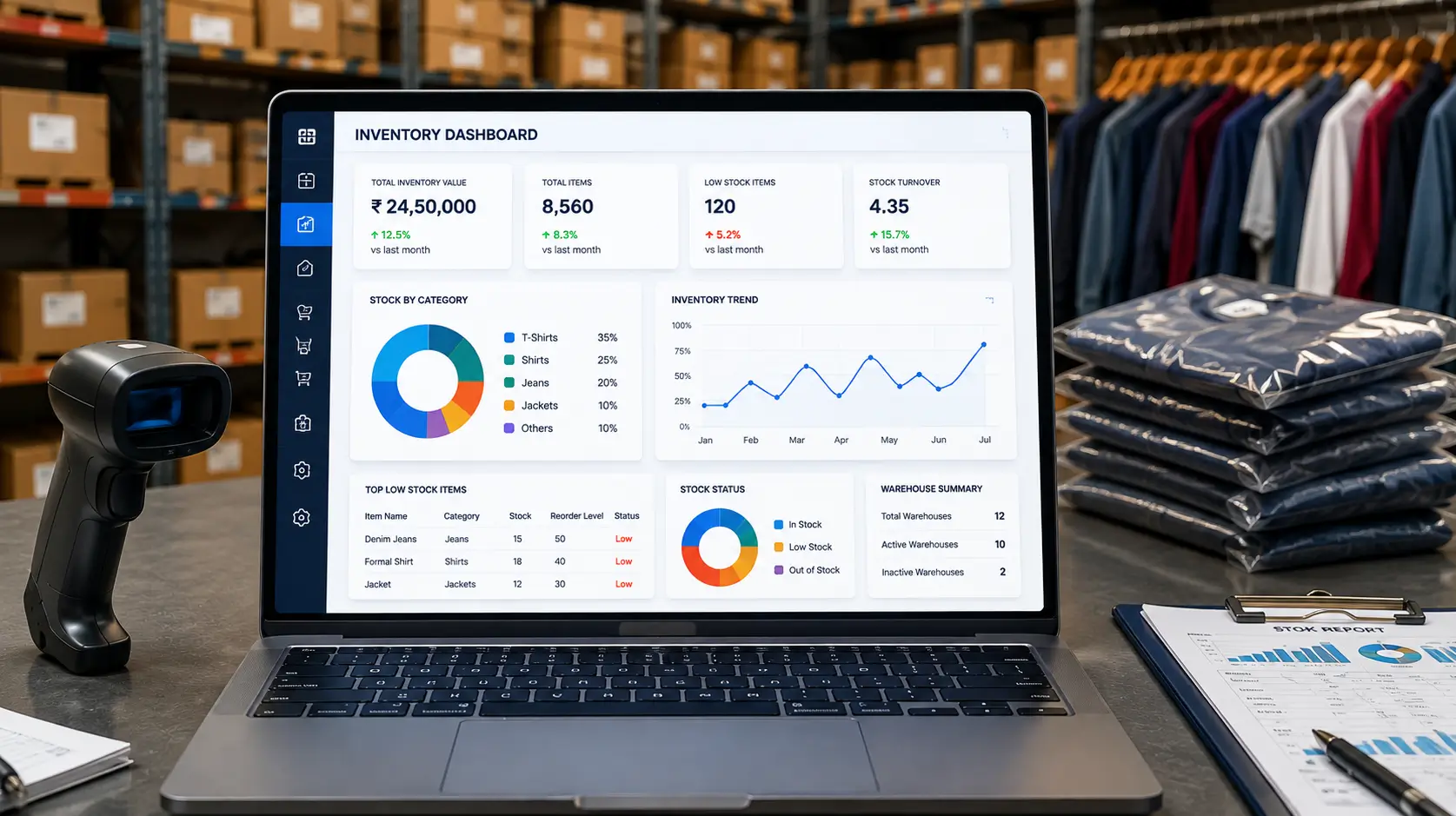
The GRetail Web Portal’s Inventory Dashboard gives you this visibility from your browser – so you don’t have to be physically in every store to know what’s ageing where.
4. Onboard New Festive Styles Fast With Garment Store Management Software
When new festive collections arrive from suppliers, speed of onboarding determines how many selling days you extract from them. Every day a new style sits in the stockroom un-barcoded, un-priced, and unavailable at the billing counter is a day of potential revenue lost.
Manual onboarding of a garment style – creating individual SKUs for each colour-size combination, assigning barcodes, setting MRP and tax rates – can take hours per style when done on generic software. On purpose-built garment store management software, the style-color-size matrix generates all variants in one step:
- Create the style master once
- Select applicable colours and sizes- the system generates the full matrix automatically
- Assign barcodes in bulk
- Set pricing at the style level, with size-specific overrides where needed
- Push to all store locations simultaneously
New arrivals go from stockroom to live at the billing counter in hours, not days. During a festive season where new drops are arriving weekly, this speed compounds.
5. Prepare Your Counters for Festive Season Garment POS Billing Volume
Festive season billing is nothing like a regular Tuesday. Counters run for 12+ hours. New or temporary staff are on the POS. Customer queues form during peak hours. Errors made under pressure – wrong size billed, wrong price applied, GST miscalculated – damage both cash flow and customer trust right when you can least afford it.
Your garment POS billing system needs to be fast, accurate, and built for the way garment stores actually operate:
- Quick style and barcode lookup – staff find the right product in two keystrokes, not by scrolling through hundreds of generic SKUs
- Size-wise quantity entry in a single bill – bill multiple sizes of the same style on one line, not as separate items
- Multiple payment modes – cash, UPI, card, and split payments handled in one transaction without manual workarounds
- Automatic GST invoice generation – compliant tax calculation with HSN codes, no mental arithmetic at the counter
- Discount and scheme application – festive offers applied automatically by the system, not improvised by the billing staff
This is what separates generic billing software from purpose-built GST billing software for garment businesses. See exactly what garment-specific counter billing looks like in practice on our GSoft POS features page.
Pre-season action: Run a billing drill with every counter staff member at least two weeks before peak. Test all hardware – barcode scanners, receipt printers, payment terminals. Identify the slowest operators and give them extra practice time while it’s still quiet.
6. Wholesale Garment Orders This Festive Season: Don’t Let Anything Fall Through
Garment wholesalers and brands selling to retailers face their own version of festive season pressure – exhibitions running week after week, buyer visits, and large bulk orders that all need to be captured, processed, and dispatched accurately and on time.
When wholesale garment orders are captured on paper or WhatsApp during an exhibition, the failure modes are predictable:
- Orders misplaced before they reach the back office
- Quantities incorrectly re-entered during manual keying
- Dispatch teams working from incomplete or outdated order lists
- Cash flow forecasting based on an order book nobody fully trusts
A mobile B2B ordering app like G-Order eliminates every one of these failure modes. Sales reps book wholesale orders directly on their phone at exhibitions or during buyer visits. Those orders sync to the ERP back office in real time – no re-entry, no lost paper, no version confusion between the field team and the warehouse.
During festive season, when exhibitions stack up and your back office is already handling peak retail volume, this kind of automation is what separates operations that scale cleanly from ones that crack under load.
7. Set up Your Reporting Dashboard before Festive Season Garment Business Peaks
When the festive rush is live, you don’t have time to configure reports. You need your dashboards already set up, your key metrics already visible, and your daily review routine already in place – so checking the business health takes 10 minutes in the morning, not an hour of chasing data.
Set up and review these reports before peak begins:
- Sales Analytical Dashboard – daily sales vs. target, by store, by category, and by style
- Inventory Dashboard – live stock position across all locations, by style-colour-size
- Fast & Slow Moving Report – which festive styles are breaking out vs. which need a promotion push
- Supplier Portal – give key vendors visibility into stock positions and purchase status, reducing the back-and-forth
- Stock Health Analysis – a daily check on overstocked, healthy, and critically low categories
All of these are live in GSoft ERP’s GRetail Web Portal – accessible from a browser on your phone or laptop, from anywhere, without needing to be on the shop floor or at a desktop terminal.
Owner routine: During festive weeks, spend 10 minutes every morning on the Sales Dashboard and Inventory Dashboard. Know what sold yesterday, what’s running low, and what needs a push. That’s the difference between responding to problems after they happen and preventing them entirely.
8. Plan Your Festive Season Promotions Well in Advance
Festive season discounts, schemes, and loyalty offers work best when they’re planned and loaded into the system before the season starts – not improvised on the day a competitor drops prices and you need to respond in an hour.
A structured Navratri and Diwali apparel sales promotion plan has three phases:
- Pre-season offer (2–3 weeks before peak): Drive early footfall and move carry-forward stock. Bundle deals, multi-buy schemes, or category-specific discounts.
- Peak-season scheme (during Navratri, Diwali, Eid, and wedding season): Fresh arrivals at compelling pricing. Loyalty point multipliers for repeat customers. Cashback offers tied to payment gateway partners.
- End-of-season clearance (post-Diwali through December): Aggressive markdown on anything that didn’t move at full price. Flash sale windows during specific days.
Load all of this into the ERP before the season starts. Counter staff apply the right scheme automatically based on the product and date – no mental arithmetic, no inconsistency between staff members, no “he gave me a discount but she won’t” customer complaints.
9. Manage Your Team Through the Long Festive Season
A festive season that burns your team out by mid-October isn’t a win – it’s a liability that costs you in November and December when the wedding season is still running. Staff exhaustion leads to billing errors, short tempers with customers, and post-season attrition that forces you to rehire and retrain at the worst possible time.
Build your people plan before the season, not during it:
- Shift rosters designed for sustainability – rotate counter staff through peak hours so no one is billing alone for 12 hours straight
- Temporary seasonal staff hired and trained before peak hits – the worst time to onboard new billing staff is when the queue is out the door
- Clear escalation paths – billing disputes, stock queries, return requests, and customer complaints all need a defined process so floor staff aren’t making judgment calls unsupported
- Role-based ERP access for temporary staff – new seasonal hires can be set up for counter billing only, without access to pricing rules, reports, or inventory settings, reducing the risk of errors or misuse
Planning for your team’s sustainability is planning for your customer experience. The two are directly connected.
10. Review, Measure & Learn – After Every Festive Season
The best garment businesses treat the post-festive period as structured learning time – not just recovery. What you measure after this season becomes the brief for next season’s preparation.
Questions worth answering with data, not memory:
- Which styles were the top 10 sellers? Should they anchor next season’s range?
- Which categories under delivered? Was it a buying problem, a display problem, or a pricing problem?
- Where did operations strain most – billing queues, dispatch delays, or stock outs?
- How did actual sales compare to budget, by store and by category?
- Which promotional schemes drove the highest conversion?
Your Sales Analytical Dashboard, Bill-wise Reports, and Fast & Slow Moving Reports from the GRetail Web Portal give you precise, data-backed answers to all of these. That analysis — done while the season is still fresh – becomes the foundation that makes next festive season better than this one.
Festive Season Readiness Checklist for Garment Businesses
Work through this 6–8 weeks before your festive peak:
- Run Stock Health Analysis – identify fast movers, slow movers, and dead stock by location
- Place purchase orders with key suppliers before August rush
- Set markdown pricing for ageing and carry-forward stock
- Confirm all new style masters are set up in ERP with correct SCS matrix, barcodes, and pricing
- Test all POS billing terminals, barcode scanners, and payment terminals
- Load festive season promotion schemes into the ERP billing system
- Brief all counter staff on festive offers, billing workflows, and escalation processes
- Set up Sales Analytical Dashboard, Inventory Dashboard, and Ageing Reports in GRetail Web Portal
- Configure G-Order B2B app for all field sales reps attending exhibitions
- Plan shift rosters and hire + train temporary staff before peak, not during it
- Set a post-season review date before the season even starts
How GSoft ERP Helps Garment Businesses Win Every Festive Season
GSoft ERP, a product of Alpha ERP Solutions, is purpose-built for garment retailers, wholesalers, and manufacturers across India. It gives you the operational infrastructure to run a high-volume festive season without the chaos.
- Garment-native POS billing – fast, GST-compliant counter billing built for style-colour-size selling
- Festive season inventory management – style-colour-size stock control with real-time visibility across all store and warehouse locations
- G-Order B2B app – mobile wholesale order capture at exhibitions and buyer visits, synced directly to the back office
- GRetail Web Portal – browser-based Sales Dashboard, Inventory Dashboard, Fast/Slow Moving, Ageing, and Supplier Portal reports accessible from anywhere
- Purchase management – track every PO, GRN, and supplier bill without spreadsheets
- Banking and payment integrations – pre-built with ICICI, HDFC, YES Bank, Pine Labs, and more for fast, smooth checkout
- GST-compliant accounting – books stay updated automatically through the entire festive rush
See everything on the GSoft ERP Retail page, check pricing plans, or read more on the GSoft ERP Blog.
Frequently Asked Questions
1. How should a garment business prepare for the festive season?
Start 6–8 weeks before peak with a stock health audit using your garment inventory management software. Identify fast movers, slow movers, and gaps. Place purchase orders early, clear old stock through markdown pricing, load festive promotions into your billing system, and set up reporting dashboards so business numbers are visible from anywhere throughout the season.
2. What is the best ERP software for garment businesses during festive season?
The best ERP for garment businesses during festive season is one with native style-colour-size inventory, fast garment POS billing, B2B wholesale order management, and real-time web reports accessible remotely. GSoft ERP is purpose-built for Indian garment businesses and covers all of these in one integrated system.
3. How do garment wholesalers manage bulk orders during festive season exhibitions?
With a mobile B2B ordering app like G-Order, field sales reps book wholesale orders directly on their phone at exhibitions. Orders sync to the ERP back office in real time – no paper, no re-entry, no lost orders.
4. How can garment retailers track stock during the festive season rush?
GSoft ERP’s GRetail Web Portal gives garment retailers live access to their Inventory Dashboard, Stock Health Analysis, and Fast & Slow Moving Reports from any browser, so owners and managers can monitor stock across all locations without being physically present in every store.
5. What reports should a garment business track during festive season?
At minimum: Sales Analytical Dashboard (daily sales vs. target), Inventory Dashboard (live stock by style-colour-size), Fast & Slow Moving Report (which festive styles need restocking vs. promotion), Stock Ageing Report (slow movers that need markdown), and Supplier Portal (purchase and delivery tracking). All are available in GSoft ERP’s GRetail Web Portal
6. How does GST billing software help garment businesses during festive season?
GST billing software automates tax calculation based on HSN codes and applicable slabs, generates compliant invoices instantly at the counter, and keeps accounting updated in real time — removing the manual GST reconciliation burden that builds up during high-volume festive billing.
Final Thoughts
The garment businesses that come out of the festive season with strong numbers, clean books, and intact teams aren’t necessarily the ones with the best product. They’re the ones who were operationally ready before the season started.
Who knew their stock before buyers arrived? Who billed fast without errors. Whose wholesale orders didn’t fall through the cracks at exhibitions? Whose owners could see the business numbers from anywhere, at any time?
That readiness runs on the right systems. And the best time to put those systems in place is before the festive rush – not during it.
Book a free demo with GSoft ERP and go into this festive season with the operational foundation your garment business deserves.